
Topographic Survey for Proposed Solar Farm Development
Published on by James Wyllie
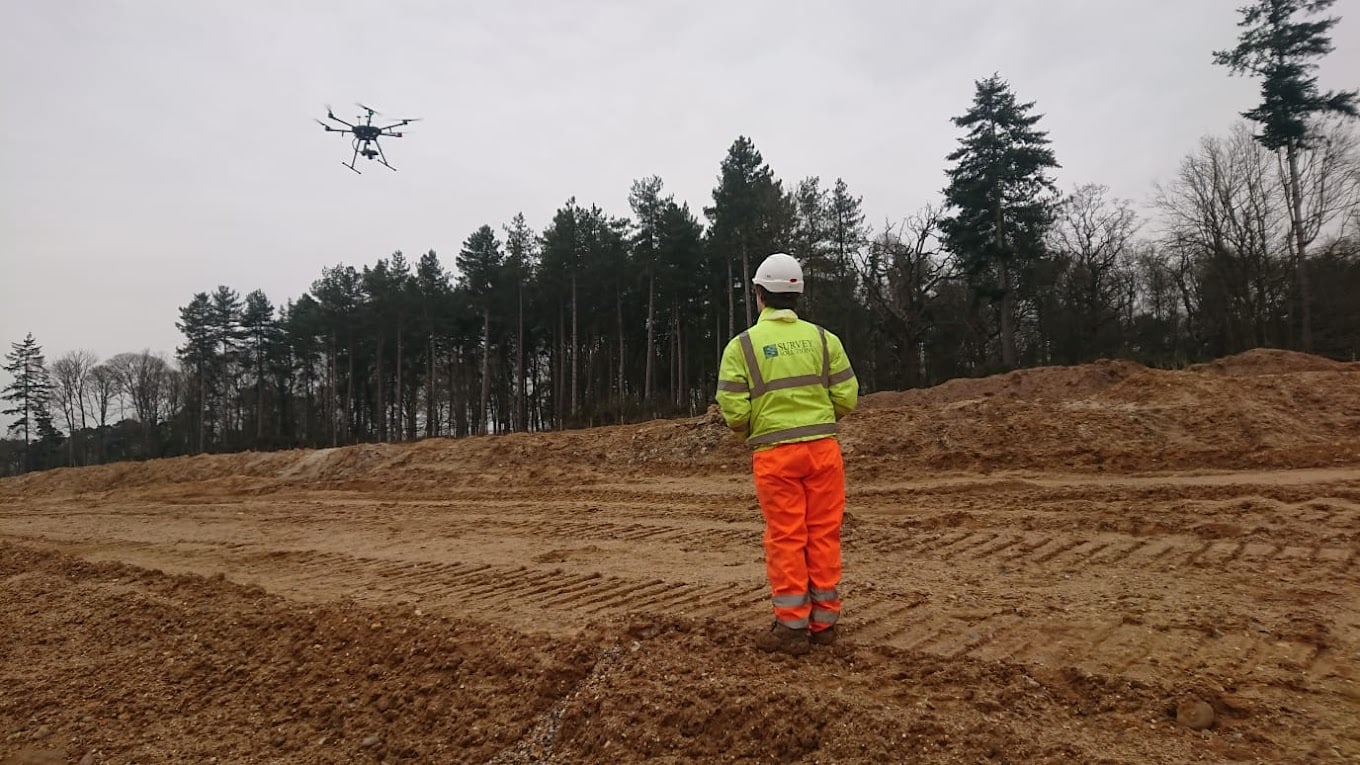
Survey Solutions was commissioned to conduct a detailed topographic survey of approximately thirty hectares of agricultural land for a proposed solar farm development in Lincolnshire.
The survey was required to provide the client with accurate information on the fields, boundaries, access road, terrain, and overall site levels. This information would support the early design and planning stages of the proposed renewable energy scheme, helping the project team understand the site constraints and opportunities before progressing further design work.
The Challenge
The project required the efficient capture of accurate survey data across a large area of open fields, including soft ground conditions and an access road that was busy at times.
Surveying the access road presented one of the main challenges. To ensure the work was completed safely, Survey Solutions operated as a two-person team and set up on the grass verge where possible, allowing the road data to be captured accurately while maintaining a safe working position.
The size and terrain of the fields also meant that a traditional survey-only approach would have taken longer to complete. Survey Solutions therefore needed to select a methodology that would deliver the required level of accuracy while allowing the fieldwork to be completed efficiently and with minimal disruption.
Our Approach
Survey Solutions used a combined survey methodology, bringing together traditional survey techniques, GPS data capture, and drone technology.
A Trimble S5 total station was used to capture high-accuracy data along the access road, where precision was particularly important. A Trimble R780 GPS was used to survey the field boundaries and establish control, allowing the team to move efficiently across the site. A DJI Matrice 300 drone was then used to capture a large volume of data quickly and accurately across the soft field areas, including spot levels throughout the site.
By combining these three methods, Survey Solutions was able to balance speed, accuracy, and site practicality. The drone survey enabled extensive field data to be captured quickly, while the GPS and total station provided the accuracy and control required to validate and support the final deliverables.
The survey took place in November, when reduced vegetation helped improve the effectiveness of the drone photogrammetry process and supported the capture of accurate ground levels.
The Outcome
Survey Solutions completed the site work ahead of schedule, enabling the client to receive the final drawings earlier than expected. The combined methodology enabled the team to capture survey data across the access road, field boundaries, and wider site terrain, while also checking the accuracy of the drone data during the survey process. This approach provided the client with reliable information for the proposed solar farm development and helped accelerate the early design process.
The project demonstrated Survey Solutions’ ability to integrate the latest survey technology with traditional methods. Unlike providers who may specialise only in either drone capture or traditional surveying, Survey Solutions was able to combine in-house drone capability, survey equipment, and technical expertise to deliver a complete and efficient solution.
As part of the drone methodology, Survey Solutions also produced an orthomosaic image of the site. This created a single, high-resolution visual record made up of thousands of individual images, allowing the client to view and interrogate the site as it appeared at the time of survey.
The result was a high-quality topographic survey package that supported the client’s renewable energy project, reduced programme time and provided a clear visual and technical record of the site.