Why Structure Gauging Surveys Are Critical To Rail Safety And Infrastructure Planning
Published on

By Jake Gaskell
Jake Gaskell – Managing Director of Rail
Every railway structure has a defined space through which trains must pass safely. Even minor changes to infrastructure or track alignment can affect these clearances, making accurate surveying essential to maintaining a safe, compliant railway.
Structure gauging surveys provide the precise dimensional data needed to confirm that bridges, tunnels, retaining walls and other lineside structures offer enough clearance for trains using the route.
This data helps infrastructure owners, operators and maintainers, including Network Rail, TfL and Nexus, maintain compliant clearances. It also supports designers and contractors during repairs, renewals and new infrastructure projects.
What Is A Structure Gauging Survey?
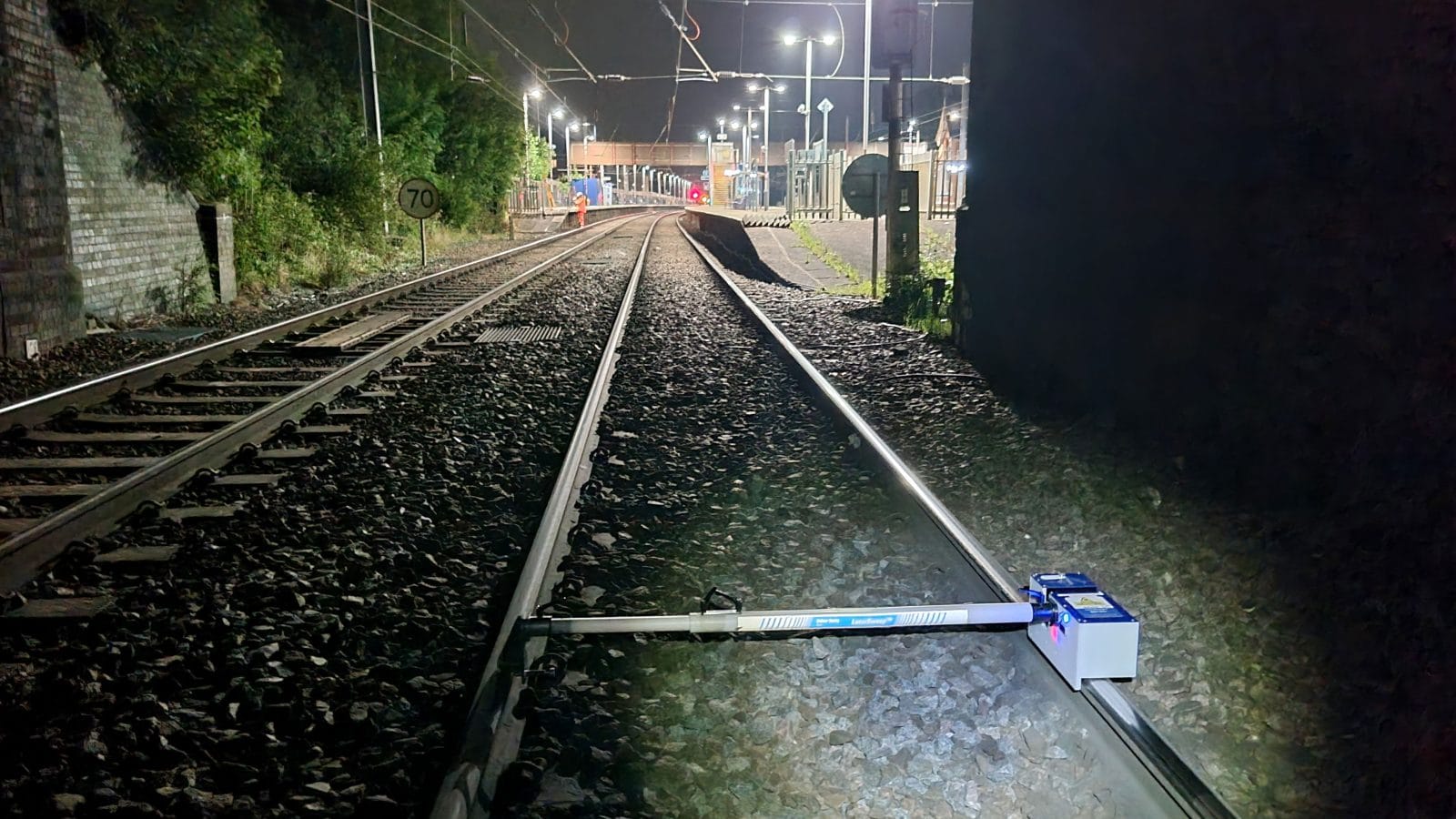
A structure gauging survey captures a series of accurate two-dimensional cross-sections through railway structures relative to the position of the rails.
Unlike traditional topographic surveys, the primary aim is to show the relationship between the track and structures that could potentially conflict with passing rolling stock. Structure gauging does not replace a topographic survey, rather it is an additional item that would be captured in addition to a track alignment survey.
As part of Network Rail requirements, all permanent structures found within 2.5 metres of the nearest running rail must be surveyed. This includes:
- Bridges
- Tunnels
- Retaining walls
- Signal structures
- Signage
- Platforms
- Fencing
- Lineside equipment
- Any other fixed asset that could affect train clearance
The resulting survey provides an accurate representation of the available space surrounding the railway.
Specialist Equipment Approved By Network Rail
Structure gauging surveys require specialist equipment that has been approved for use on Network Rail infrastructure. Currently, only six approved electronic gauging systems can be used to undertake these surveys. These fall into two categories.
Two systems, from Laser Rail and Abtus, use electronic distance measurement (distometer) technology, employing a mirror to accurately orientate the laser beam towards the structure being measured.
The remaining four systems use high-precision laser scanning technology, including solutions from Trimble, Leica, Amberg and RILA. These systems rapidly capture detailed survey information while accurately recording both the position of the rails and every measured point on the surrounding structure.
Using approved equipment ensures the survey data meets Network Rail standards and provides the accuracy needed for structural clearance assessments.
How Structure Gauging Data Is Used
Once the structure gauging data is collected, it forms the basis of a structural clearance assessment. The assessment determines whether each type of rolling stock operating on a route can safely pass through or alongside a structure.
The assessment considers key factors including:
- Surveyed clearance between the structure and track – The actual measured clearance between the structure and the track.
- Measurement tolerance of the equipment used – Every survey device has a margin of accuracy, which varies between the approved instruments. The assessment factors for this tolerance use the smallest, realistic clearance, rather than assuming the measurement is perfect.
- Track alignment and Cant (superelevation) – The horizontal and vertical position of the track, including Cant, the height difference between the two rails on a curve. By raising one rail above the other, it causes trains to lean as they pass through the curve, altering the vehicle’s position relative to nearby structures.
- Kinematic envelope of the rolling stock – The three-dimensional “swept” space a train occupies while moving, which is larger than the train’s static outline. It accounts for the vehicle’s movement, and each type of rolling stock has its own envelope.
- Centre and end throw – On curves, the centre of a carriage moves inward while the ends move outward. This movement can bring the train closer to nearby structures on curved sections.
- Track fixity classification – A low, medium or high rating that indicates how much the track may move over time, depending on its construction. Greater movement potential requires a larger clearance allowance.
- Vehicle roll and sway – The lateral lean and side-to-side movement of a train caused by its suspension, Cant and dynamic forces in motion. This can bring the vehicle body noticeably closer to a structure than it would be when stationary.
- Structure deflection or movement – Some structures aren’t entirely rigid and can flex, settle or shift over time. Where relevant, the assessment allows for this potential movement, so the clearance remains valid.
These factors allow engineers to decide whether sufficient clearance exists for safe train operation.
Supporting Rail Design And Infrastructure Upgrades
Structure gauging surveys play a vital role throughout the design and maintenance of the railway. When developing new track alignments, Track Designers rely on precise gauging information to ensure proposed designs stay compliant with clearance requirements.
Similarly, whenever new rolling stock is introduced onto a route, every relevant structure must be assessed to confirm the new trains can safely run without conflicting with existing infrastructure. This process reduces operational risk while helping avoid costly redesigns or infrastructure modifications later in the project.
Maintaining Network Rail’s Gauging Database
Network Rail keeps a comprehensive gauging database holding clearance information for every structure across the rail network.
To ensure accuracy of this information, structures are periodically resurveyed based on their clearance category. Depending on the level of risk and available clearance, structures are typically surveyed between one to eight years.
Regular surveys ensure changes caused by track movement, maintenance activities, structural deterioration or infrastructure upgrades are accurately reflected within the national database.
The Importance Of Survey Accuracy
Railway clearances are often measured in millimetres. Minor inaccuracies can have significant implications for train operation, infrastructure design and regulatory compliance.
High-quality structure gauging surveys provide engineers with confidence that design decisions are based on reliable data, helping reduce project risk while supporting the safe movement of passengers and freight across the network.
Using approved survey methodologies and specialist equipment also ensures consistency with Network Rail standards and enables seamless integration into the national gauging database.
Need Support With A Structure Gauging Survey?
Survey Solutions delivers high-quality, rail surveying services across the UK’s rail infrastructure, supporting contractors, designers, consultants and infrastructure owners.
Our experienced rail survey teams work safely within live railway environments, using industry-approved technology to deliver, high-quality data that meets Network Rail requirements and supports safe, efficient project delivery.
Whether supporting track renewals, route upgrades, clearance assessments or wider rail infrastructure projects, we provide the information needed to make informed engineering decisions with confidence. Complete the form below to discuss your project requirements.