
The Role of Site Engineering in Successful Construction Projects
Published on
By Toni Abrahams
Construction projects rely on accurate information, careful coordination and precise execution from the very first day on site. While design teams develop detailed plans and specifications, it is site engineering that ensures those designs are accurately translated into the built environment.
Whether delivering a commercial development, infrastructure scheme or residential project, effective site engineering helps maintain quality, improve efficiency and reduce the risk of costly errors throughout construction.
What is Site Engineering?
Site engineering is the process of applying engineering and surveying principles during construction to ensure that structures are built in the correct location, at the correct level and to the required tolerances.
Working between the design office and the construction site, site engineers use survey data, digital models and engineering drawings to guide construction activities. Their role is to ensure that what is built accurately reflects the approved design while adapting to the practical realities of working on a live construction site.
As projects become increasingly complex and digitally driven, site engineering has become an essential part of delivering safe, efficient and high-quality construction.
Why Accurate Setting Out Matters
Setting out is one of the first technical activities undertaken on a construction project and forms the foundation for everything that follows.
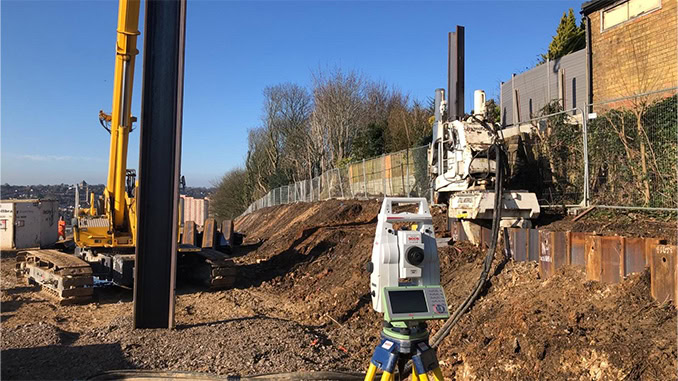
Using survey control, robotic total stations and GNSS technology, site engineers transfer the design from drawings or BIM models onto the ground. This establishes the precise locations for foundations, structural steelwork, walls, drainage, roads and other construction elements.
Even small inaccuracies during setting out can have significant consequences later in a project. Misaligned foundations, incorrectly positioned columns or inaccurate levels can lead to delays, rework and increased costs. Accurate setting out helps avoid these issues by ensuring construction begins from a reliable reference point.
Quality Assurance Throughout Construction
Site engineering does not end once construction begins. Throughout the build programme, ongoing verification ensures completed works continue to meet the required design tolerances.
Regular dimensional checks and as-built surveys allow construction teams to confirm that structures have been built correctly before subsequent stages commence. Identifying discrepancies early reduces the risk of larger issues developing later, when corrections become more expensive and disruptive.
This continual verification also provides an accurate record of completed works, supporting quality assurance processes and project documentation.
Improving Programme Efficiency
Construction projects involve multiple trades working simultaneously, often to demanding programmes. Accurate site engineering provides confidence that each stage of work can proceed without unnecessary delays caused by positioning errors or conflicting information.
By providing reliable survey control and engineering data, site engineers help improve coordination between contractors, designers and project managers. This enables construction teams to make informed decisions quickly and maintain progress throughout the project lifecycle.
Supporting Safe Construction
Health and safety remain central to every construction project, and site engineering contributes in several important ways.
Accurate survey information helps reduce uncertainty on site, allowing construction activities to be planned more effectively. It also minimises the need for rework, reducing unnecessary exposure to construction risks and helping teams complete work safely and efficiently.
On complex or constrained sites, detailed engineering surveys can also help identify access limitations, structural constraints and potential hazards before work begins.
The Technology Behind Modern Site Engineering
Advances in survey technology have transformed the way site engineering supports construction.
Robotic total stations, GNSS receivers, laser scanners and digital data collection allow engineers to achieve high levels of accuracy while working more efficiently than ever before. Increasingly, these technologies are integrated with Building Information Modelling (BIM), enabling survey information to move seamlessly between design, construction and asset management teams.
Digital workflows also improve traceability, allowing project teams to verify construction against approved models and maintain accurate records throughout the build.
Challenges Site Engineers Help Overcome
Every construction project presents unique challenges. Restricted access, changing site conditions, evolving designs, live working environments and demanding programmes all require practical engineering expertise.
Site engineers play an important role in responding to these challenges by providing accurate information when decisions need to be made quickly. Their ability to identify potential issues early helps minimise disruption and supports smoother project delivery.
As projects become larger and more technically complex, this proactive approach becomes increasingly valuable.
Why Site Engineering Remains Essential
Modern construction demands greater accuracy, faster delivery and higher levels of quality than ever before. Site engineering provides the technical foundation that enables these expectations to be achieved.
From establishing precise survey control and setting out works to verifying completed construction and supporting digital delivery, site engineering helps ensure projects are built correctly, efficiently and safely.
For contractors, developers and consultants, investing in accurate site engineering is not simply about meeting specifications. It is about reducing risk, improving programme certainty and delivering projects with confidence from the ground up.